Blog
.png)
There's a paradox at the heart of Brazilian healthcare: the brands that invest most in visual identity are the ones that struggle most to maintain it at scale.
BP is a defining example. Founded in 1859 by Portuguese immigrants, the institution spent 166 years building an identity that breaks every sector cliché. Purple and orange instead of blue and white. An energetic tone instead of a clinical one. Photography that radiates human warmth and Brazilian diversity instead of international stock images.

That differentiation is a strategic asset. It's also an operational headache.
Generic stock libraries delivered the opposite of what BP needed: international stock photos with no Brazilian representation, none of the vibrant tones from BP's palette, none of the human warmth that the brand had built as its differentiator. The team would search, adapt in Photoshop, try to bend something generic toward the brandbook. The result was rarely real BP.
And there was always the risk the team describes with precision:

The problem wasn't a lack of resources to produce — it was the absence of a source that could consistently deliver BP DNA, at volume, with the Brazilian character and human warmth the brand demands. The images stock libraries offered didn't feel Brazilian and didn't connect with Brazilian reality.
The cost was double: hours spent on adaptive execution — searching for what doesn't exist, fixing what doesn't fit — and a visual identity that, however well-constructed, was held hostage by the limitations of whatever went in. What was left for strategy and communication planning was whatever remained after all of that.
BP wasn't looking for a tool to generate more images. It was looking for a way to generate images no one would mistake for another brand's.
That distinction matters. Any AI image generation tool produces volume. What Pupila delivers is different: a Brand Studio configured with the brand's specific identity — palette, photographic style, composition, representation — as a permanent generation layer. The model doesn't produce generic images with BP's color applied on top. It produces images that are born inside BP's DNA.
The moment of clarity for the team came when they saw the first images generated with the configured style:
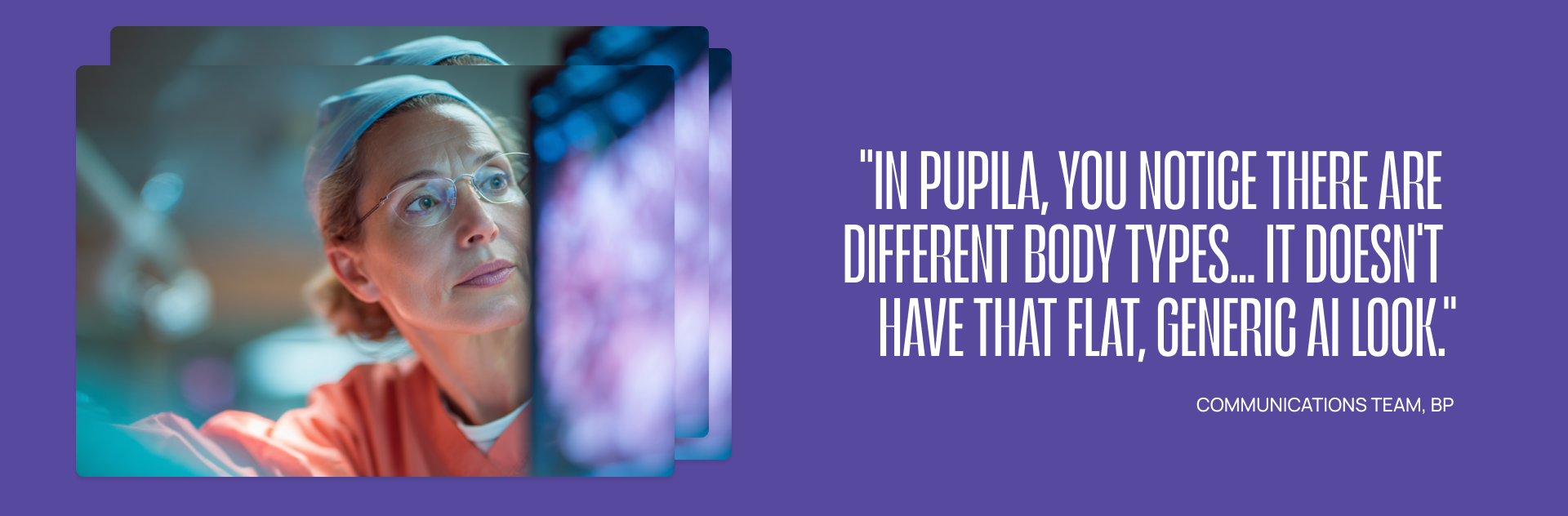
Images with authentic Brazilian diversity. With the characteristic human warmth. With a vibrant palette that doesn't feel artificial. Images that were unmistakably BP.
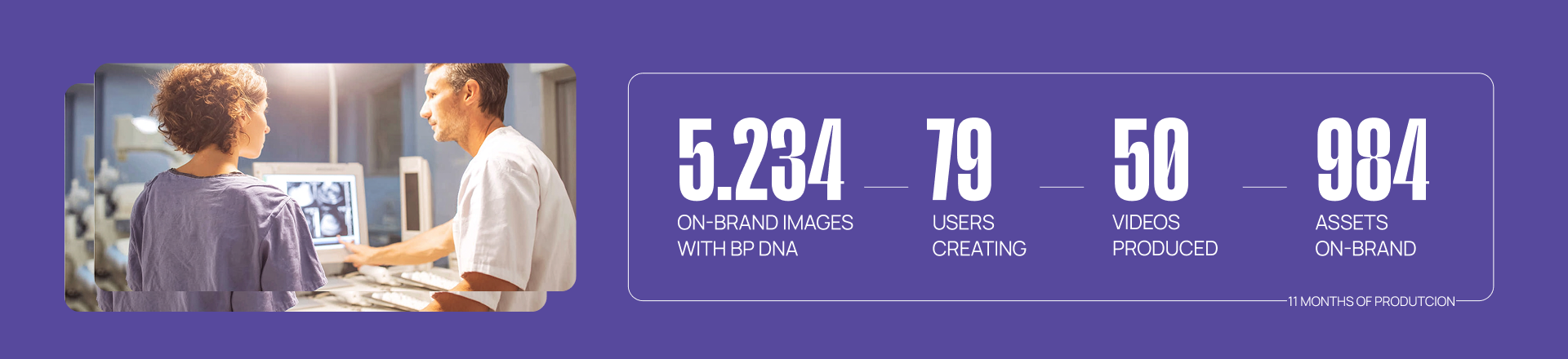
The Brand Studio was configured to faithfully reproduce BP's visual DNA: a vibrant purple and orange palette, a photographic style with authentic Brazilian diversity, human warmth, and compositions that carry the "more realistic approach" that sets the brand apart in healthcare. With the brandbook integrated as a generation layer, every image produced is born in BP's standard. BP generated 5,234 on-brand images in 11 months, with 18 different creators maintaining visual consistency across every project.
Pupila went beyond static imagery. BP completed 50 videos and 376 copywriting tasks on the platform — copy aligned with the brand's voice and positioning, dynamic materials for different channels. An identity that once depended on photography now extends across every communication format, at the same level of consistency.
What started in the central communications team expanded without an internal campaign, without forced training. HR and Social Projects requested access after seeing the materials being produced. Today, 79 users across multiple departments at BP are on the platform — creating materials that carry BP's DNA regardless of who produced them.
The results: 11 months of on-brand production

BP created 5,234 images with BP DNA in 11 months of operation in the Brand Studio — with 18 different creators maintaining the same visual standard. Beyond images, it produced 50 videos and completed 376 copywriting tasks, totaling more than 5,600 creative pieces with BP's identity preserved. The platform recorded 984 downloads — assets that left Pupila and went into real communication: events, presentations, campaigns.
In 11 months, BP went from a central team using the platform to 79 registered users across multiple departments. In April 2026 — the account's second-highest production month — 9 users from different departments created 886 assets. The expansion wasn't forced. It was the consequence of perceived quality.
Roberta Landucci, from BP's team, created a presentation about the institution's history for the CRM team — filled with images generated in the Brand Studio. The feedback was spontaneous: "Wow, Lu, what a great presentation! What beautiful images!" — with no one knowing the origin, no one questioning the quality, and everyone immediately recognizing the identity.
BP's Christmas Kit followed the same path: a holiday dinner image generated in Pupila, described internally as "very warm, with diversity." Colleagues praised it. The brand was recognized. The tool, invisible.
BP has already shown that Pupila goes beyond the central communications team. HR and Social Projects operate on the platform. The natural next step is expanding to the institution's sub-brands — BP Mirantes, BP Pesquisa, BP Vital, BP Medicina Diagnóstica, BP Educação — each with its own specific identity within the BP umbrella, all producing communication on brand.
The goal that opens up: a 166-year-old organization with a unique visual identity, where any department can create communication that feels like BP. Not AI-generated. BP.
The Brand Studio encodes the brand's visual guidelines — palette, photographic style, composition, representation — as native generation parameters. Every image produced starts from the brand's DNA, not from a generic template with the identity applied afterward. For brands with an identity as specific as BP's — vibrant palette, Brazilian representation, a distinctive photographic style — that difference determines whether the result is recognizable as BP or could belong to any other company.
BP uses the Brand Studio for image, video, and copywriting. In 11 months, it produced 5,234 images, 50 videos, and completed 376 copywriting tasks — all with the brand's visual and verbal identity preserved. Pupila functions as an on-brand creative production hub, not just an image generator.
BP has 79 registered users across multiple departments — communications, HR, Social Projects — not all of whom have a design background. The brandbook functions as a guide embedded in the generation process, which means the output carries the brand's identity regardless of who produced it. The expansion to other departments happened organically, without forced training.
BP produced its first assets in May 2025, and by June of that same year already had 414 images generated with 5 active users. The adoption curve was fast because the perceived value was immediate: in the first internal stakeholder presentation of materials, the spontaneous reaction was surprise at the quality.
BP — with over 166 years of history, Latin America's largest private healthcare hub, and one of the most distinctive visual identities in the sector — uses Pupila Brand Studio as its creative production infrastructure. The platform allows healthcare institutions to maintain their specific identity at scale, without relying on generic stock libraries.
Founded in 1859 by Portuguese immigrants, BP is today Latin America's largest private healthcare hub. With over 166 years of history, the institution brings together hospitals, diagnostic medicine centers, research units, and health education under a visual identity unlike anything else in the sector: a vibrant purple and orange palette, an energetic tone, and an aesthetic that communicates warmth and vitality. BP operates in São Paulo and serves patients from across Brazil.
Pupila is a brand technology platform powered by AI that combines brand intelligence with artificial intelligence — enabling marketing teams to create on-brand visual and written expression at scale, without choosing between consistency and speed.
<
>


All rights reserved @ 2024
All rights reserved @ 2024