Blog
Leading CMOs share their biggest AI challenges in marketing and the practical solutions they've implemented. Learn how to scale creativity responsibly while keeping humans in the driver's seat.
As AI continues to transform the advertising landscape, marketing leaders are responding with both excitement and caution. According to Ad Age's November 2025 AI Marketing Playbook, nearly all chief marketing officers are navigating the uncertainties surrounding AI adoption—but the good news is that many have created effective solutions and guardrails.
As Laura Jones, Chief Marketing Officer of Instacart, perfectly puts it: "AI is a creative superpower, not a substitute for human insight." She emphasizes that the focus should be on "using it to scale creativity responsibly and keep marketers firmly in the driver's seat."
Let's explore the five biggest challenges marketing leaders face with AI—and the innovative solutions they've implemented.
The Challenge: Laura Jones from Instacart identifies the core tension: "Our biggest challenge is keeping the balance between speed and stewardship. AI is helping us move faster than ever, but we're focused on using it to enhance, not replace, human creativity."
The Solution: Instacart learned this lesson firsthand in 2023 during early experiments with generative imagery. They created a recipe calling for chicken thighs, but the AI-generated image showed two whole chickens conjoined—a clear disconnect that customers noticed immediately.
"It was a good reminder that AI can't yet replicate human taste or judgment," Jones noted. "You need a human in the loop."
After this experience, Instacart built stronger guardrails and trained a closed AI model using their own brand visuals. The results? They've cut video production timelines by 160 hours per project using tools like Capsule and PlayAI, while their marketers maintain creative control over storytelling.
The Challenge: Christina O'Rourke, Director of Creative Strategy and Content at United Airlines, articulates a universal concern: "Our biggest challenge is separating the AI hype and its potential from the reality of the here and now."
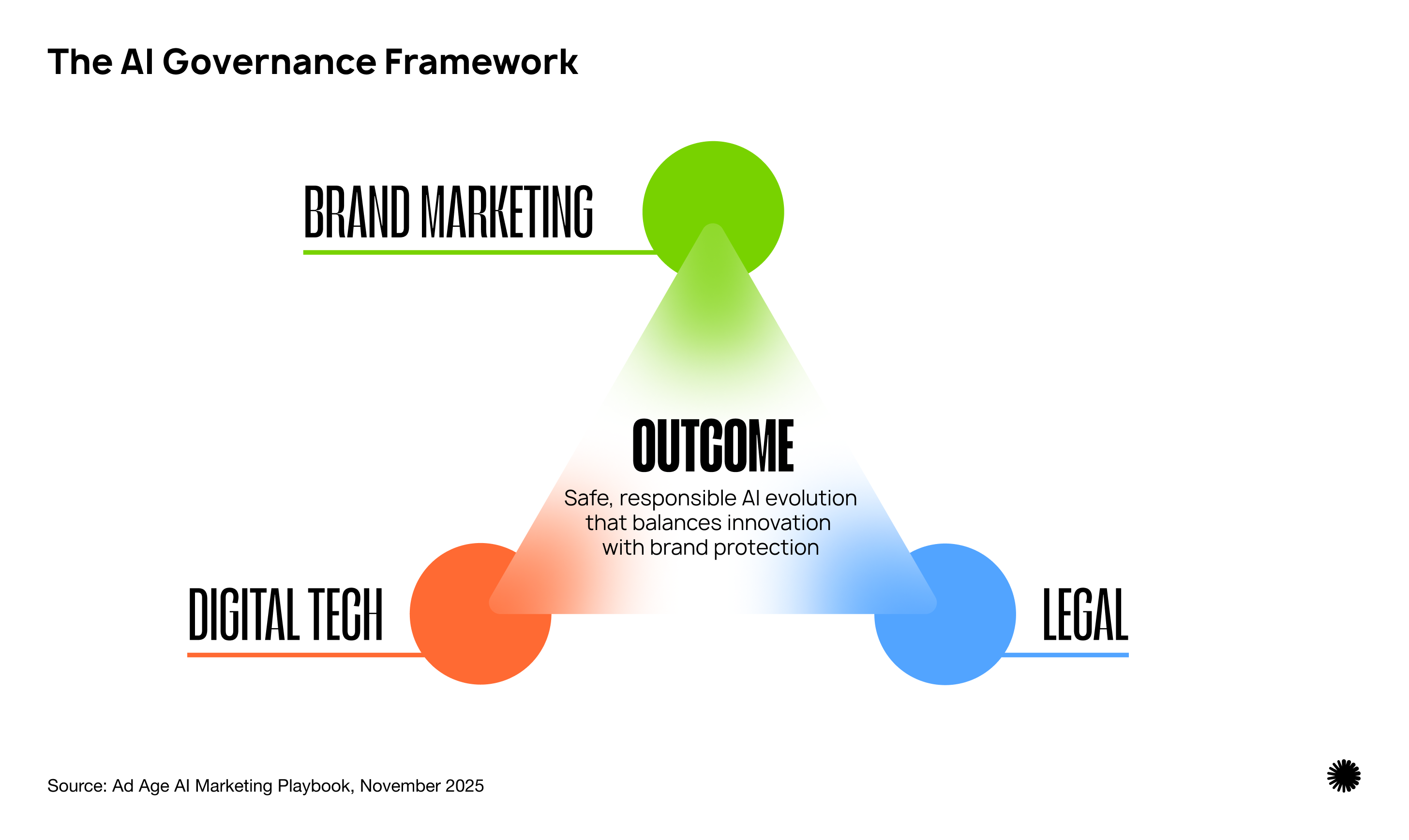
The Solution: United Airlines has taken a collaborative governance approach. "Generative AI has evolved at a mind-bending pace, and that puts marketers in a tricky spot," O'Rourke explains. "We have to navigate the excitement around AI adoption while building the right governance to ensure it's used responsibly."
The key? Cultivating tight collaboration between brand marketing, digital technology, and legal teams. This cross-functional approach ensures that AI evolves their marketing efforts safely and effectively.
The Challenge: Jinal Shah, Chief Customer and Marketing Officer at Zip, raises a critical concern: "My biggest worry with AI is its potential to make people intellectually complacent and tasteless. I worry that over-reliance on AI will create acceptance for tasteless genericness. And taste is the je ne sais quoi that takes marketing, product design, and communication experiences from good to great."
The Solution: Shah's approach is elegantly balanced: encourage intensive AI usage while simultaneously developing human capabilities. "Because we are at the frontiers of possibilities, the only way I can address this is by encouraging intensive usage of AI while also encouraging my team to explore their own voices and develop their points of view."
Her philosophy? Richer inputs into AI will yield richer outcomes. By encouraging both technology adoption and creative growth in tandem, teams can achieve "a more graceful dance between humans and AI."
The Challenge: Debbie Woloshin, CMO of Stitch Fix, focuses on maintaining empathy: "Balancing efficiency and the irreplaceable human element [is a challenge]. AI provides tremendous opportunities to improve how we work—it helps us move faster, surface insights quicker, scale creative production, and deepen personalization. However, what AI cannot provide is empathy."
The Solution: Stitch Fix demonstrates this through their Retail Therapy brand platform, which spotlights the pain points of traditional shopping. "Telling these stories requires a human touch that AI can't replicate," Woloshin emphasizes.
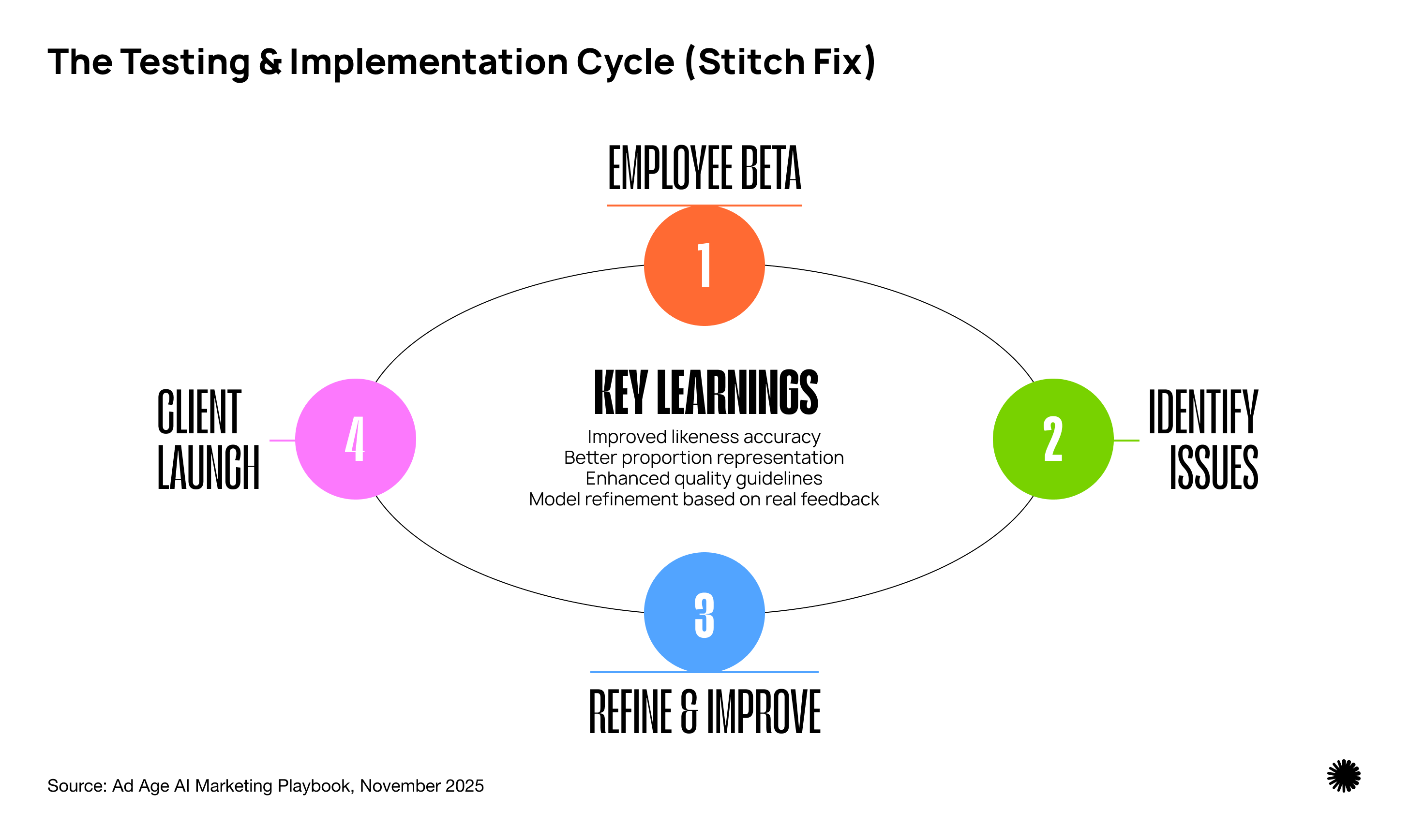
When launching Stitch Fix Vision—their Gen AI-powered style visualization tool—they implemented a strategic beta testing approach. By rolling it out to employees first, they identified moments where AI "didn't quite get it right," such as imagery that didn't fully capture a person's likeness or proportions. These learnings informed improvements before the client launch, from refining the model to implementing quality guidelines.
The Challenge: Mike Zeman, CMO of Life360, identifies the homogenization risk: "The technology is evolving so fast that our challenge is learning how to move just as quickly, experimenting with new tools while keeping our creative standards high. The risk is that if everyone relies on the same models and similar enough prompts, the creative outputs risk becoming more and more similar."
The Solution: Life360 made a bold choice—they used real animation instead of AI for a recent campaign, and audiences noticed. The most-liked comment on the original TikTok, with over 30,000 likes, thanked them for "using real animators." When they followed up with behind-the-scenes content showing the animation process, it earned nearly two million views.
"It was a good reminder that audiences are still craving a human touch and, at least for now, will reward brands that maintain it," Zeman notes.
His approach? "If we have to choose between saving money and maximizing our chances for a true and novel creative breakthrough, we'll choose the latter." For Zeman, AI's biggest upside is automating marketing workflow, project management, and basic content creation—freeing people to focus on bold ideas and storytelling.
The consistent theme across these marketing leaders is clear: AI is most powerful when it amplifies human creativity rather than attempting to replace it. The successful implementations share common characteristics:
As we move into 2026, the competitive advantage won't go to those who use AI the most—it will go to those who use it most thoughtfully, maintaining the human elements that create authentic brand connections.
Source: Ad Age, "AI Marketing Playbook," November 4, 2025
<
>


All rights reserved @ 2024
All rights reserved @ 2024