Blog

The AI Marketing Strategy Summit 2026 brought together names like Kieran Flanagan (HubSpot), Scott Galloway, and executives from Estée Lauder, Zapier, and Palo Alto Networks to discuss the new marketing playbook with AI.
Research presented at the event revealed something beyond tools and workflows: 44% of marketing professionals are anxious about AI's implications for them, personally.
Not about the industry. About their own careers.
Another finding drew attention: while technical implementations advance rapidly, there's a disconnect in experience. 53% of VPs report "widespread adoption," but only 20% of professionals feel the same.
It's not about who's right. It's about recognizing that technical transformation and human transformation happen at different speeds — and both need deliberate attention.
Summit research showed a pattern: 53% of Marketing VPs report "widespread AI adoption" while 20% of professionals agree. (Source: AI Marketing Strategy Summit 2026)
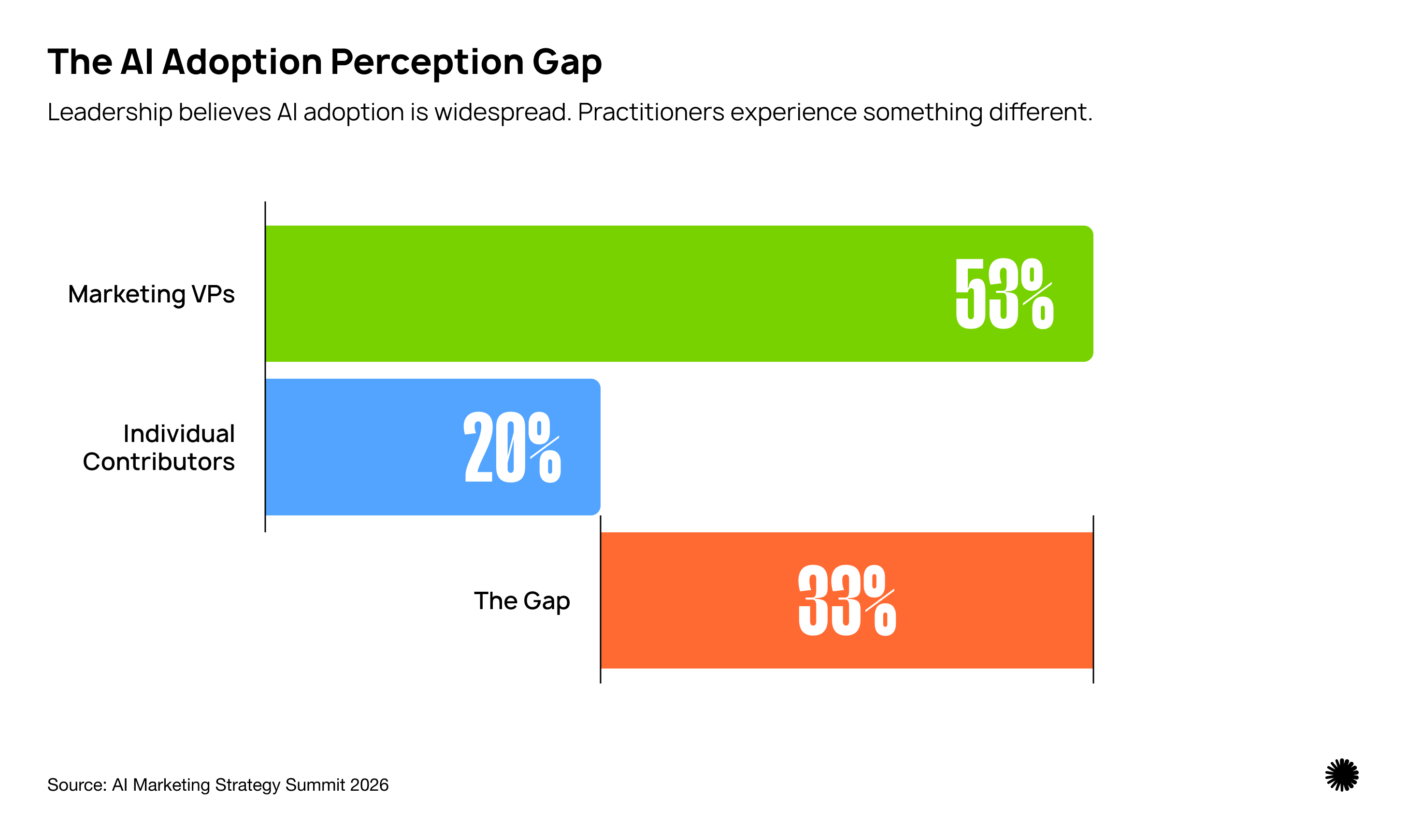
This doesn't indicate communication failure or inadequate implementation. It indicates that technical deployment and real integration into daily work happen at different speeds.
Leadership naturally measures milestones: tools licensed, training completed, budgets allocated. Professionals measure transformation by change in day-to-day work.
These are real productivity improvements. But the distance between "using AI tools" and "having workflow transformed by AI" is larger than it appears. And it's in this distance that professional reconstruction happens.
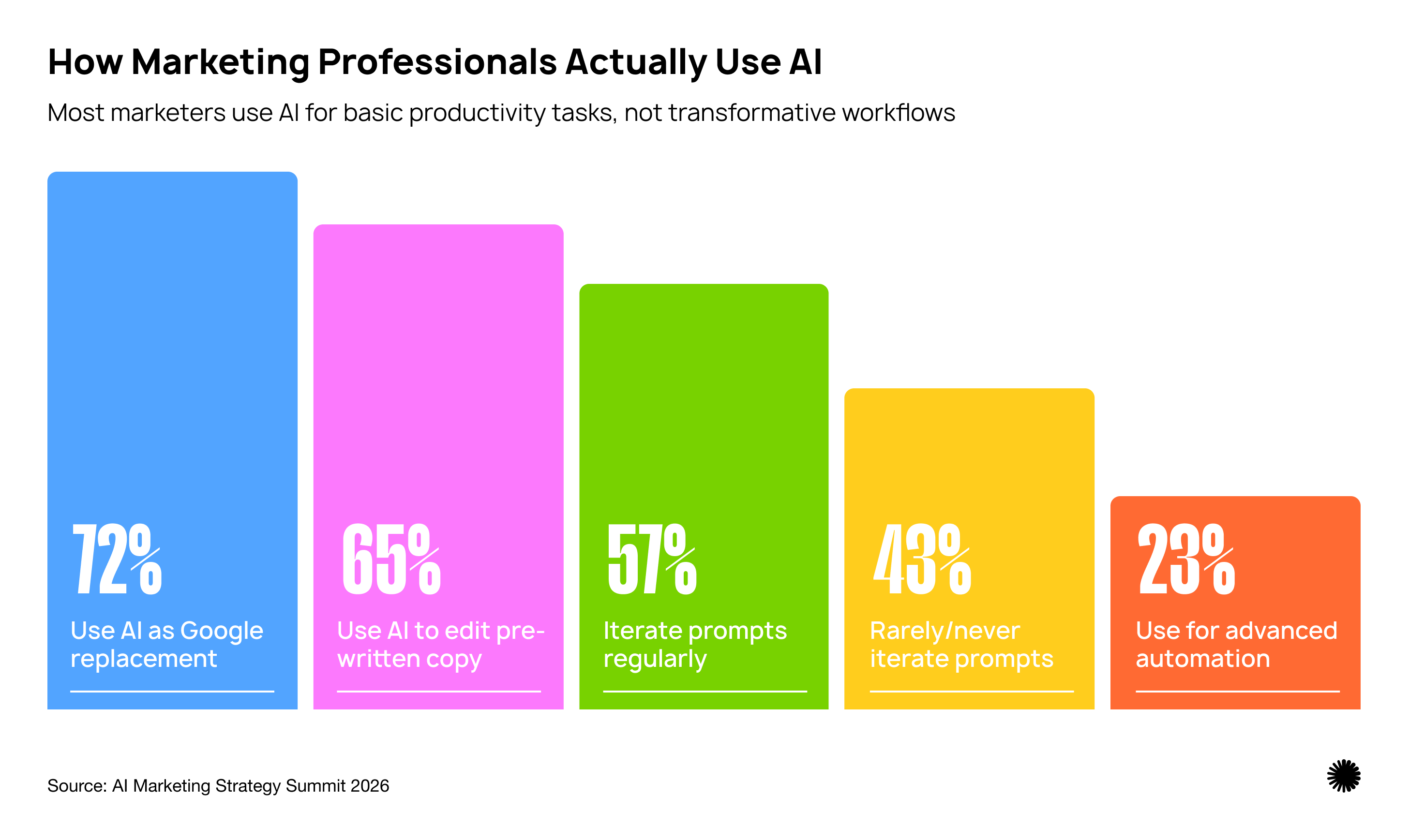
Tools get implemented in quarters. Professional identity reconstructs over years.
A senior copywriter who spent 15 years mastering brand voice now sees AI generate on-brand headlines in 30 seconds. A designer who built a career on concepting sees AI produce 50 variations overnight.
The question that emerges: "If AI does this part, where's my unique contribution?"
It's not resistance to technology. It's the natural process of redefining professional value when automation takes over significant parts of execution. And this redefinition needs structured support, not just organic evolution.
Research presented at the Summit identified three stages professionals go through when redefining their value in AI-augmented environments. (Source: AI Marketing Strategy Summit 2026)
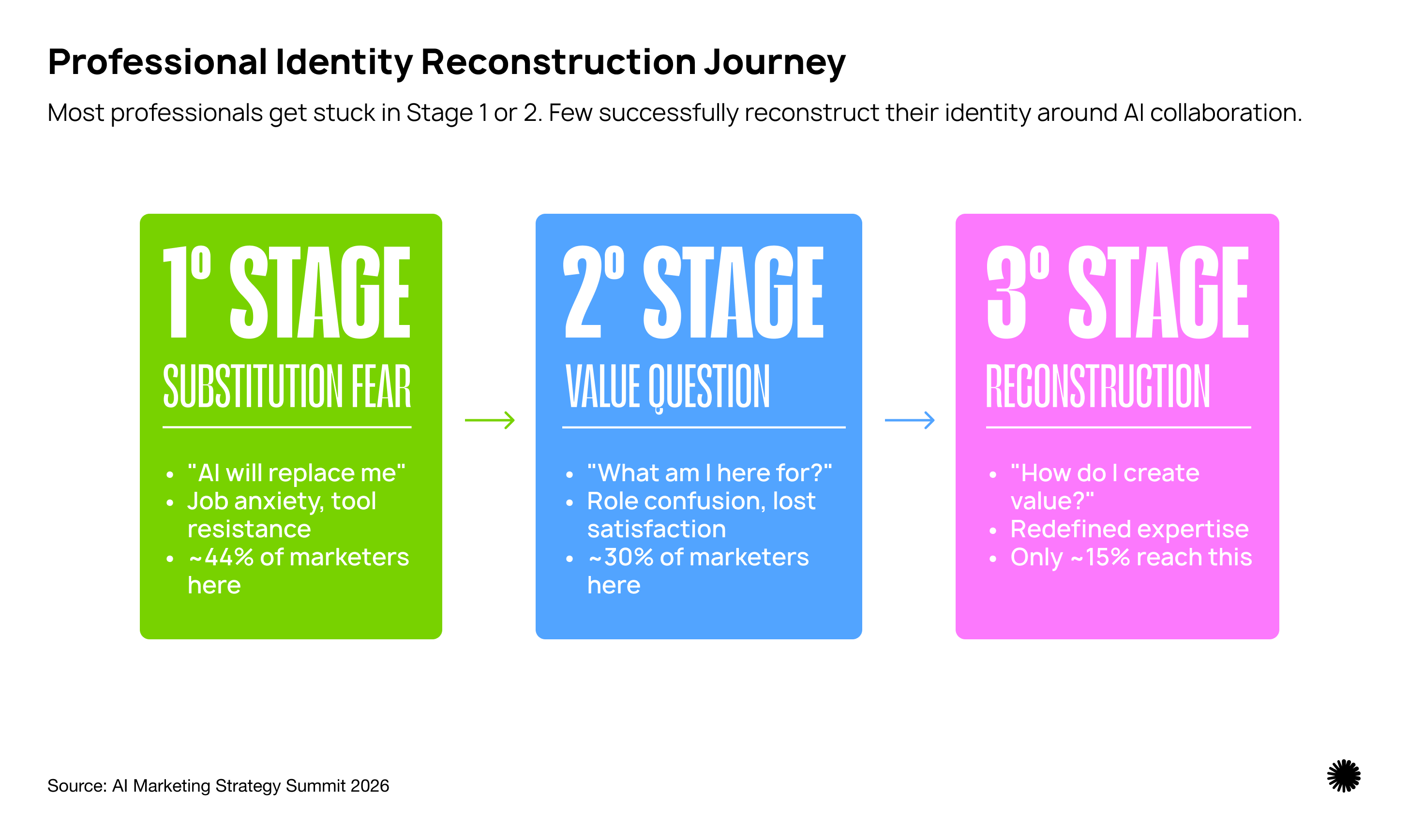
The initial reasoning: AI executes core tasks faster and cheaper, therefore there's substitution.
But what actually happens: automation of repetitive execution frees capacity for work requiring human judgment — decisions in ambiguous contexts, creative direction, relationship building.
The challenge: organizational clarity about what that higher-value work is.
"If AI handles execution, what do I do?"
Summit example: Content strategist redistributes time from execution (writing/editing) to strategic decisions (frameworks, critical AI review, strategic calls).
Professional identity reconstructs around collaboration, not competition with AI.
Summit quote: "Before, pride in 3 perfect directions. Now, I explore 30 with AI and identify the 3 with real potential. I'm not less creative — I'm creative across more surface area."
Expertise migrates from execution to curation. From production to taste-making. But getting here requires structured support, not just individual willpower.
Study presented at the Summit analyzed 249 leaders managing AI implementation. The finding: 0.81 correlation between ability to lead people and ability to lead AI workflows. (Source: AI Marketing Strategy Summit 2026)
Strong leaders with people are strong with AI. Weak leaders fail at both.
Why? Because the fundamental challenge hasn't changed: getting work done through others (whether people or systems). This requires clear objectives, useful constraints, actionable feedback.
Practical implication: Investment in leadership development multiplies in the AI context. Organizations that neglected this will struggle regardless of tools.
Framework presented at the Summit for creating support structure during professional identity transitions:
"We know many are redefining how they create value here. These are legitimate questions we need to work through together."
Recognition without drama. Validation without paternalism.
Prompt engineering workshops ≠ discussions about role evolution.
You need both. They're different conversations.
Profile people from your own team who navigated the change. Let them share: what they feared, what changed, what they gained.
Concrete examples help more than abstract concepts about "focusing on strategy."
Permission to discover new ways of creating value. Time not completely allocated. Safety to express doubts.
These structures don't delay implementation — they accelerate it by reducing passive resistance and increasing genuine engagement.
Realistic timeline: Tools in months. Identity reconstruction in years. Plan for both speeds.
Underestimated investment: Leadership development becomes highest-leverage. Leadership quality determines if AI creates value or confusion.
Opportunity: Professionals with deep execution expertise can become your best AI power users — if they navigate transition with adequate support.
AI implementation in marketing has two speeds:
Technical transformation: Tools, workflows, automation — happens in months.
Human transformation: Professional identity reconstruction, value redefinition, new sources of satisfaction — happens in years.
Summit data is clear:
Successful AI strategies accommodate both speeds. Not just the technical one.
Professional reconstruction will happen anyway. The question is whether it happens with structured support or organically — with all the costs that implies.
SOURCES:
All data and findings in this article come from the AI Marketing Strategy Summit 2026, including:
Teams that implement creative AI sustainably don't separate technical from human transformation. At Pupila, we work with teams from major brands like Banco do Brasil and Mercado Livre to structure workflows that scale creative production while maintaining brand consistency — and make sense for those operating the tools day-to-day.
<
>


All rights reserved @ 2024
All rights reserved @ 2024